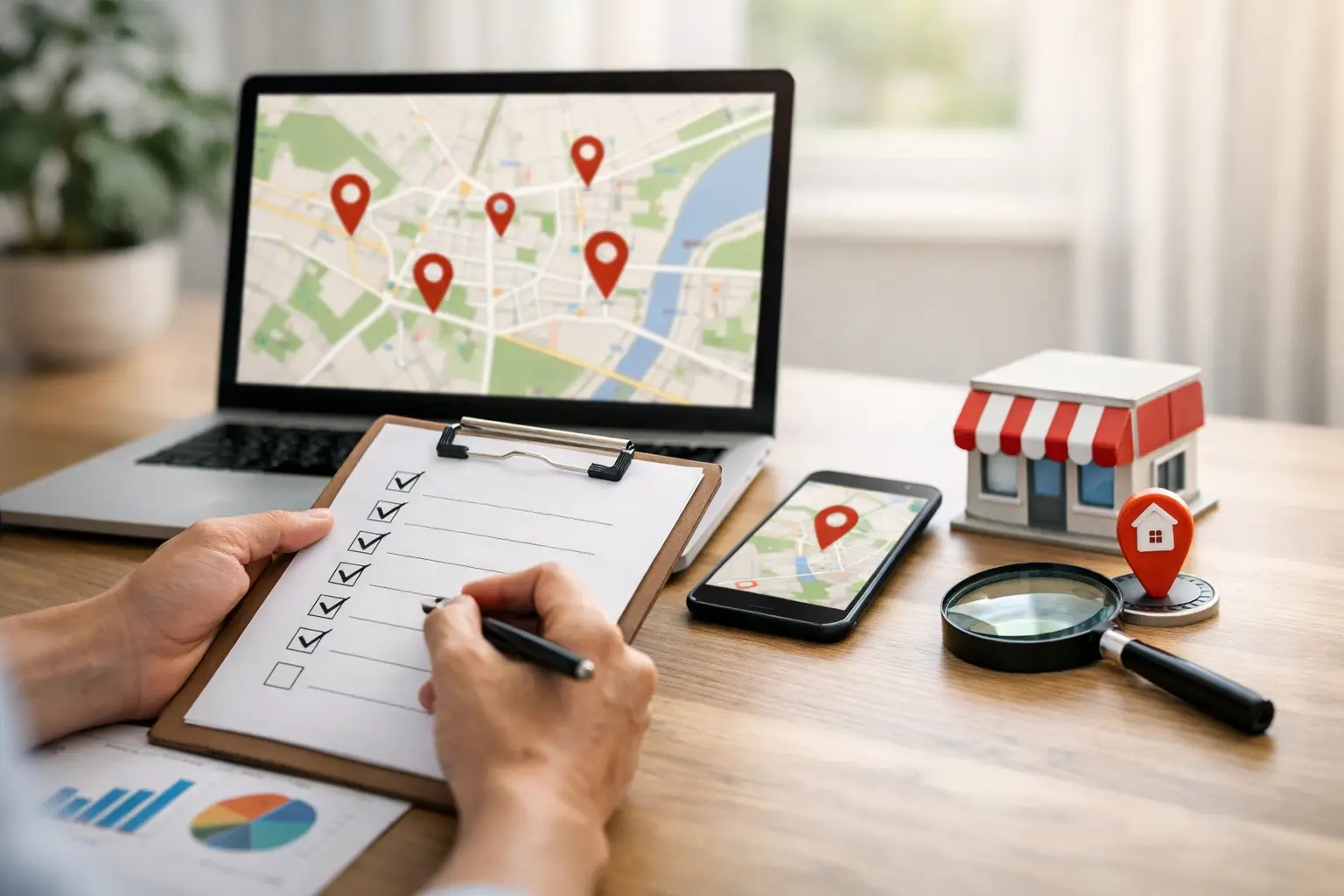
A nearby customer searches for your service, sees three businesses in the map results, and makes a call within minutes. If your company is missing from that moment, the problem is rarely one single ranking factor. This local SEO audit checklist helps uncover the visibility gaps, trust signals, and website friction standing between your business and more qualified local leads.
For a Houston contractor, law firm, medical practice, home service company, or multi-location business, local search is not a vanity metric. It is a customer acquisition channel. A focused audit shows where your digital presence is losing ground and which fixes deserve immediate ownership.
Start With the Local Search Results That Matter
Begin by searching the terms real customers use when they need your service. Use a browser that is not signed into your business accounts, and test from the city or neighborhoods you serve. Search variations such as “roof repair near me,” “Houston family lawyer,” or “commercial electrician in Katy.”
Review both the map results and the standard organic listings. A business can rank reasonably well in one area and disappear a few miles away, especially in competitive markets. Local rankings are influenced by proximity, relevance, prominence, and the consistency of your business information across the web.
Pay attention to which competitors consistently appear. Look beyond their ranking position. Are they earning more reviews? Do their service pages answer specific local needs? Is their brand more recognizable? The goal is not to copy a competitor’s website. It is to identify the signals they have earned that your business has not yet built.
Local SEO Audit Checklist: Your Google Business Profile
Your Google Business Profile is often the first version of your brand a local customer sees. An incomplete or neglected profile can limit visibility before a visitor ever reaches your website.
Confirm that your business name, address, and phone number match the information on your website and other key listings. Do not add extra keywords to your business name unless they are part of the real-world name customers see on signage, invoices, and legal records. Short-term manipulation can create verification issues and weaken trust.
Then review your primary category. This selection tells Google what your business is most directly known for, so it should reflect your highest-value core service. Add secondary categories only when they accurately represent services you actively provide. A broad list may feel comprehensive, but relevance wins over clutter.
Your profile should also include complete business hours, an accurate service area where appropriate, a concise business description, current photos, and service details. Photos matter because they make an unfamiliar company feel established and real. Use images of your team, completed work, office, storefront, vehicles, or process instead of generic stock images whenever possible.
Finally, check the link to your website and the appointment or quote path. A profile that generates attention but sends customers to a broken page, generic homepage, or slow mobile experience is leaking leads.
Check Reviews for Trust, Not Just Volume
Reviews are a visibility and conversion asset. A high star rating helps, but the audit should go further. Review frequency, recency, response quality, and review themes all shape a customer’s decision.
Read your latest reviews alongside those of the businesses ranking above you. Are customers mentioning the exact services and locations you want to be known for? Are complaints surfacing around scheduling, communication, or pricing? Search performance cannot compensate for an operational issue that repeatedly appears in public feedback.
Build a repeatable process for asking satisfied customers for reviews after a successful project, appointment, or purchase. Do not offer incentives or selectively request reviews only from customers you expect to be positive. A sustainable review program is based on consistent service and a simple, timely request.
Respond to every review with professionalism. Thank positive reviewers without relying on copy-and-paste language. Address negative feedback calmly, protect customer privacy, and invite an offline resolution when needed. Your response is not only for the reviewer. It is proof for the next prospect evaluating whether your team takes ownership.
Audit Your Website’s Local Relevance
A polished website is not automatically a locally optimized website. Your site needs to make it easy for search engines and customers to understand what you offer, where you offer it, and why your business is a credible choice.
Start with the essentials: your name, address, phone number, primary service area, and contact options should be easy to find, especially on mobile. If you operate from a physical location, display the address consistently. If you serve customers at their locations, explain your service area honestly without creating thin pages for every surrounding town.
Each major service deserves a dedicated page when that service is meaningful to your business and has distinct customer intent. A page for “plumbing services” may not compete well for a searcher looking for emergency leak repair or water heater installation. Service pages should explain the work, the customer problem, the process, proof points, and the next step to request help.
Local references should be useful, not forced. Mention neighborhoods, counties, landmarks, or regional considerations only where they add context. For example, a commercial HVAC company can discuss the demands of Texas heat, while a property management firm can address local leasing needs. Empty city-name repetition is not a strategy and can make a strong brand sound generic.
Check title tags, page headings, and meta descriptions for clarity. The service, location, and business value should be visible without stuffing the same phrase into every element. Searchers need confidence that they have found the right provider, not a page built for an algorithm.
Test Mobile Experience and Conversion Paths
Local customers often search from a phone while they are ready to act. A site that looks impressive on a desktop but creates friction on mobile can quietly reduce calls and quote requests.
Open key pages on multiple phones and test the journey yourself. Can a visitor tap the phone number? Can they find directions, service areas, reviews, and a quote form without excessive scrolling? Does the form ask only for information your team truly needs to begin the conversation?
Page speed deserves attention, but speed should be evaluated alongside usability. Large images, unnecessary scripts, and complex page features can delay the experience. At the same time, removing every visual element to gain a small performance improvement may weaken trust. The right balance depends on your audience, your site, and what is actually slowing the customer down.
Track meaningful actions, including calls, submitted forms, booked consultations, direction requests, and qualified chat conversations. Traffic without attribution makes it difficult to decide what to improve next. Your audit should connect rankings and visibility to the outcomes that move revenue.
Verify Citations and Business Data
A citation is any online mention of your business name, address, phone number, or website. Inconsistent information can confuse customers and search platforms, particularly after a move, rebrand, phone change, or merger.
Search your company name and review the major directories, industry sites, local chambers, and relevant professional listings that appear. Correct duplicate profiles, old addresses, disconnected phone numbers, and misspellings. Prioritize listings that customers or search engines are most likely to encounter rather than spending hours chasing every low-value directory.
For businesses with multiple locations, each location needs its own accurate data, landing page, and profile strategy. Avoid funneling every location to one generic page if customers need local details, local proof, or location-specific contact information.
Strengthen Authority With Local Proof
Local prominence grows when your business earns credible signals beyond its own website. That can include community involvement, industry recognition, local media coverage, partnerships, sponsorships, and useful content that answers questions people in your market genuinely ask.
Not every business needs a content machine. A smaller professional firm may get better results from a handful of authoritative service pages, strong reviews, and accurate listings than from publishing weekly articles with no purpose. A multi-location service brand may need a larger content program to support several markets. The strategy should match the opportunity, not a generic marketing checklist.
Look for proof that reinforces the claims on your website. Case studies, certifications, project photos, client testimonials, and team credentials can improve confidence when they are specific and current. Customers want evidence that you can deliver, not just polished promises.
Turn Audit Findings Into an Action Plan
An audit only creates value when it leads to action. Separate findings into urgent lead leaks, quick credibility wins, and longer-term growth work. A wrong phone number or broken form should be fixed immediately. New service pages, review systems, and authority-building efforts may require a more deliberate plan.
Assign an owner and a deadline to every priority. If no one owns the next step, the audit becomes another document that never changes performance. WiseX3 approaches local growth with that same standard: creative execution, technical precision, and accountability tied to measurable outcomes.
Your local presence should make it easy for the right customer to find you, trust you, and take action. Start with the gaps closest to the conversion path, measure what changes, and keep improving the experience your market sees when it searches for help.